Use the right-hand vertical bar to scroll down to the next pages


... and there's more:


... and then some more:


... and more:
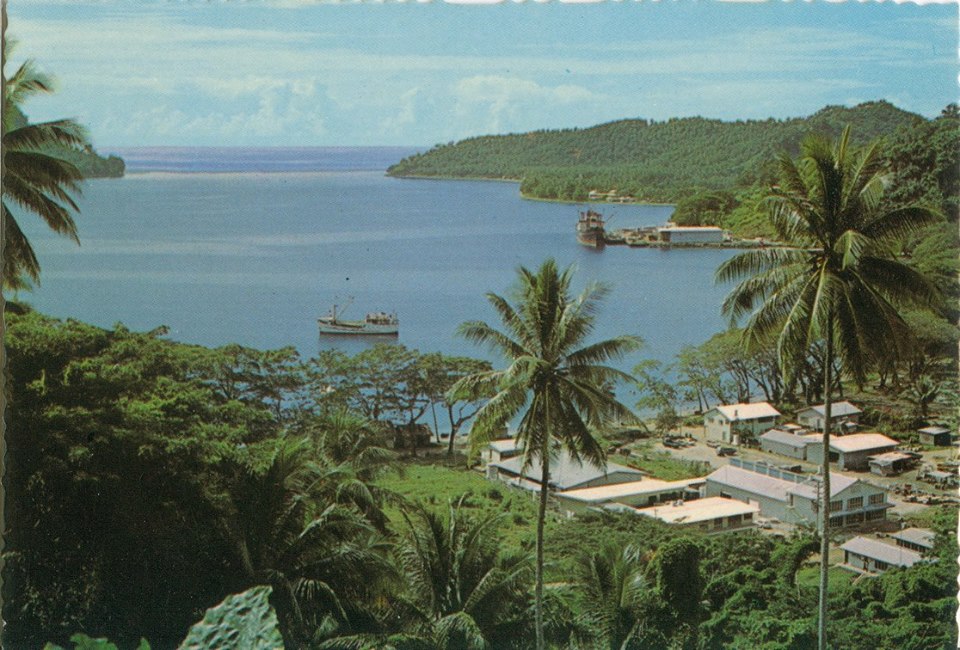
Bill Hallam had a dream to build a low-key island getaway set out like a Polynesian village with small huts on the beach largely staffed with people from the Faeds, Mortlocks and Tasmans where their families could also be based. Until then the main opportunity for men from the atolls was to work on overseas ships which meant leaving families for months on end. He wanted to celebrate local culture through the architecture and dances put on for tourists.
The customary owner of Arovo was a man from Pok Pok Main Village. When the lease for the island came up Bill, after much research, won the tender. That was in November 1969. Things were ramping up with BCL so the potential for a tourist destination was hard to ignore and after securing financial backing from private investors the project ended up much grander than initially envisaged. Construction on what was known as Arovo Tahi started in April 1970. Morobe Construction transported most of the local timber by canoe from Kieta. The Post Courier in 1971 referred to Arovo as PNG’s first true island resort.
Arovo used to put on weekly 'moo moos’ and shows. At night after dinner the staff, many who’d worked with Bill on ships since the 50s, put on amazing dances like the hula, knife-throwing and fire-twirling.
Bill died at sea in 1980 off West New Britain and was buried on Bougainville. His grave was covered in white sand and shells from Arovo and Pok Pok.
For more photos of Arovo, click here.


RTG Mining hit 52-week highs on Tuesday after the junior explorer got the green light from Bougainville locals to start work on its copper and gold mine.
The historic partnership, the first of its kind in 30 years, pushed RTG shares as high as 34.5c before they cooled to 28c — a gain of 83 per cent for the day.
Consent from the traditional land owners is required for the issue of any exploration licence on their customary land at the Panguna 1.5 billion tonne copper and gold project on the central island of Bougainville, a process which has historically escalated to wide-scale political unrest on the island.
The region has long been known for its copper and gold prospects, but disputes between regional residents and explorers such as Rio Tinto subsidiary Bougainville Copper Limited (BCL) have marred production since the early 1970s.
Conflict between the Bougainville Revolutionary Army and Papua New Guinea Defence force escalated to a civil war in 1988 and took almost ten years to cease.
Now, the Autonomous Regional of Bougainville is seeking independence for its population of 250,000, with a target date of June15, 2019 set for a referendum on the topic.
They will be the ones to decide the fate of RTG’s application, now led by the traditional landowners, the Special Mining Lease Osikaiyang Landowners Association (SMLOLA) and chairman Philip Miriori.
“We believe the proposal presented by the SMLOLA consortium represents a unique and once in a generational opportunity to responsibly re-open the Panguna Mine for the benefit of all Bougainvilleans,” the company told the market.
“RTG has always suggested that this is best achieved by discussion and negotiation with all relevant parties, including the ABG.”
In 2016, Rio’s subsidiary BCL was forced to abandon the mine in the face of attacks by rebels, transferring its take to the provincial and national governments at no cost.
Wow - I have stumbled across your website and am very grateful to you for establishing this repository of wonderful memories.
I am Andrew Wilson, son of Richard and Helen Wilson, who with my sister Julianne, arrived on Bougainville very early 1970. Helen and Richard are still in great shape, living in Sinnamon Park, Brisbane.
I'll check the facts of the following and do what I can to put together a selection of photos of our time, but largely as I recall it, Dad arrived late 1969 in a tug towing barges full of fuel, to add to the construction effort at Loloho. Dad was a BCL employee, and as far as I'm aware, had a great time in his tug for a few years during construction of the port, the power station and the precipitator (?) where the slurry from the mine was concentrated before export.
When we arrived we lived at Camp 6 and as an 8 year old, I was in complete heaven. I recall fondly our Canadian neighbours (the Hotaling's ?) the evenings in the community mess hall, where at Christmas that first year (1970) we kids where all rounded up and sang songs as part of the festivities. We where called the "Nuts and Bolts", and all us kids had a letter of the name pinned to our backs, turning around after the last song to the applause and laughs from those in the crowd.
A frightening time was a speed boat race, where two brand new, flash ski style boats with outboards had a race across the bay and back to a buoy right on the beach. A crowd assembled to watch (father and son ?) in these boats as they took off across the bay almost out of site, and came hurtling back. A yellow (?) buoy was in the water just off the reef, and to our assembled horror, one boat passed it to port, the other to starboard. They collided with one going over the foredeck of the other, its prop slicing through the deck. Abrupt silence then pandemonium, men took off across the beach into the water to find the submerged boats skipper, a short while later dragging an unconscious guy up the beach and administering mouth to mouth. First time I had seen grown men cry (and not just one).
As I recall my first school was at Toniva, and for the first few months we bounced all the way there and back in a Land Rover, and at some point went up market in Toyota, where I would weasel my way into the front seat and change gears for the driver. Great times.
At some point, school facilities where established in Arawa so the family found ourselves there, first school at Tupakas, then Bovo. We lived very close to the Bovo river, and you knew when it was raining hard up the mountains because of the noise of the boulders rumbling down the river. It was an amazing place, with so much rain, every day at the river was like your first with holders the size of cars constantly shifting.
I remember a teacher, a Mr O'Reilly who was to us kids a huge man with an enormous belly, the O in the O'Reilly !
It might have been some time in 1972 that Dad left BCL to work for the PNG government as harbour master Kieta, so Kieta ( happy valley) we went, back to school at Toniva. School uniform was a pair of swimmers and an Orange T shirt ! Bliss.
Your site has a video driving down the hill into Kieta, turning left at the bottom of the hill, past the Zero on a post, then along the beach to the Kieta sailing and cruising club - which dad and a couple of his Kiap mates (Hendo Henderson high among them) set up. The bank account was the "Kieta aleing and boozing club", and I still have a club burgee as a treasured possession. From there, sailing Quick Cats, Arafura Cadets, Sunfish, Fireball, Corsair etc, my love of sailing was born.
Along that road was the house where we lived, ( a brief shot of it in the video I think). My bed room louvers opened to the bay, and as the early morning light flooded in, so did the gentle sounds of the small waves lapping the sand, and the view across to Puk Puk. Oh my god, what memories that video has bought back. Thank you.
Clear memories of daily "gouriers", with Mt Bagana clearing her throat on an almost daily basis.
Fantastic years, more follows
Regards
Andrew Wilson
karinandrew[AT]gmail.com