The gigantic FREEPORT Erzberg job in Irian Jaya.
I was still with BECHTEL on Bougainville when they began recruiting.
What a job! What an experience!

The gigantic FREEPORT Erzberg job in Irian Jaya.
I was still with BECHTEL on Bougainville when they began recruiting.
What a job! What an experience!


New Guinea is the world's second-largest island, and with an area of 785,753 km², the largest island in the Southern Hemisphere. The U.K. is a mere 242,495 km². And yet, on most maps of the world, thanks to the socalled Mercator Projection, the two seem almost the same size.
If you want to know why this is so, read Simon Garfield's rivetting book "On the Map - Why the World Looks the Way it Does".

You can read it online at www.archive.org. Simply SIGN UP (its' free!), LOG IN and BORROW, and go straight to page 125 to read all about Mercator Projection. Here's a simple illustration what a map of the world would look line without the inflated Mercator Projection:


Chris Eastoe has written this engaging story of his short six-week stint on Bougainville Island in 1974:


To continue reading Chris's interesting tale, click here.
P.S. I did write to Chris seeking his permission to publish his story. He promptly replied, "Dear Peter, I've just spent a wonderful time looking at your blog. I am so glad that you located my stories, and included them in your blog for others to enjoy -- in the same spirit as I included Harold Elliott's story about his bombing raid on Rabaul. The stories are not in a very accessible place at present -- although you seemed to have managed to find them. My stay on Bougainville was very short compared to yours, but it was a time that has influenced the rest of my life, and not just because of the scientific research. I sometimes wonder what happened to all the Bougainville and New Guinea people I met. For the Bougainville men, the civil war must have been very difficult. The ones I knew seemed to relish the independent existence the mine had offered them -- even if the operation was wrecking their island. It would have been hard for some of them to go back and wokim gaden. I wonder if we ever crossed paths in Panguna? It sounds as though you were there when I made my visit in 1974. As you will have realized, life has taken me on a long road since those days. As part of my studies, I was able to spend a year in Nancy, France, to work on my Panguna quartz vein specimens. Eventually, a job in Tucson, Arizona came along, and I spent my professional career there. In retirement (since 2015), I have been able to spend a couple of months each year in Chinese universities, at least until the pandemic happened. I gather from your story that you originated from Germany. Where in Germany did you live? I have had a few connections with Germany over the years, mainly in the area around Frankfurt."
In 2018, after a couple of years living in nearby Arawa, Adam Constanza had an opportunity to visit and explore Panguna mine, which closed its operation in 1989, nearly three decades earlier.
As an old mate from my construction days on Bougainville said, "Could never see the mine opening again - far too much damage and cost would be mind-boggling - all the infrastructure would need to be rebuilt - including the slurry pipeline over the mountain. Everything that could be looted - has been to pay for the war Just had a look at Google map; all that is left of the power station are the rusty oil-storage tanks. Nothing left of the concentrator - such a change from when we were there!"

A Canadian reader, who toughed it out on Bougainville during the early construction days, on TUE 16 emailed this photo of a "SEIKO BELL-MATIC 17 Jewels" wristwatch which he had purchased at the Kieta shop of Green & Company.
Half a century later, it's still working! Pity the mine isn't!

There was none of that "sophisticated, high living" in Camp 1 or Camp 3 at Panguna, or in Camp 6 down the coast, or in any other of the single-men's camps. If you were early enough at meal times, you might be able to eat your meal before the long table - and the floor underneath - was littered with food left-overs and the air was thick with sweaty workers in singlets yelling at the top of their voices.
As for women, the only ones seen in the camps were waxed-to-the-point-of-martyrdom PLAYGIRLS OF THE MONTH, depicted on centerfold posters torn from PLAYBOY magazines and stuck to the inside walls of the dongas - and ceilings, too! High living indeed!
P.S. As one "old-timer" wrote after reading this (WARNING: Strong language!): "That brings back memories!!! I am not sure where the photo was taken, but more in line with the nobs in the Pink Palace. Before that there were a bevy of single girls, just after there were reports in the Aussie papers about the conditions in the mine and the huge number of well-paid men working there. There had always been adverts for female staff, secretaries, medical, and the like, but after the report in the papers the positions filled quickly, not by beauties but ranging from Plain Jane to awful, all at the end of their tether and looking for a "good catch". They lived in the wire-fenced and guarded compound just above the Bechtel office known as the "Fur Farm". Don’t know how they amused themselves; we saw them at the odd hash house harrier do but never in the camp boozers. Just above them and below the helideck on the hill were the contractors' married quarters. The rubbish boys would go through all their rubbish - after all, they had nothing and expats threw away a lot of stuff - and when they found used sanitary pads they'd wrap them around their arms and act like wounded soldiers in the movies. It used to send the women crazy who complained to the maintenance foreman."

Perhaps it is the result of having read Robert Louis Stevenson, Louis Becke and Joseph Conrad at an impressionable age, but the South Pacific islands have always evoked a powerfully romantic image with me. Mention the South Seas and I conjure up a vision of waving coconut palms and a dusky maiden strumming her ukelele. Silhouetted against the setting sun, Trader Pete (that's me!) sits in a deck-chair in front of his hut sipping a long gin and tonic while a steamboat chugs into the lagoon, bringing mail from home.

In truth, I came to the then Territory of Papua & New Guinea as an audit clerk with a firm of Chartered Accountants in Rabaul (and thereby hangs another tale). When the local newspaper, the POST-COURIER, began carrying ads for audit personnel on the Bougainville Copper Project, I applied and was invited to fly across for an interview in October 1970. In those early days, all incoming traffic stopped at the transit camp at Kobuan where one had to wait for transport to Panguna where Bechtel's "top brass" had their offices.
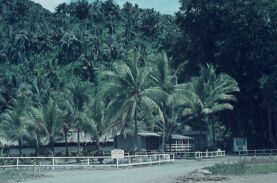
The road to Panguna was still something of an adventure and it was some time before I could present myself to Sid Lhotka, Bechtel's Manager of Administrative Services. He hired me on the spot and I returned to Rabaul to give notice and get my things and within a few weeks I was back "up top" only to be told that I would be working at Loloho, senior auditor in charge of several large contracts such as the construction of the harbour facilities (built by Hornibrook), the Power House construction (built by World Services), the Arawa Township (built by Morobe-ANG), and the haulage services (provided by Brambles-Kennellys.) Des Hudson and a string of time-keepers, amongst them Neil Jackson ("Jacko"), Bob Green, and "Beau" Players joined the team later.
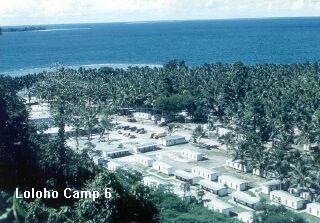 Camp 6 at Loloho
We all lived in Camp Six which was idyllically situated on Loloho Beach. Every day (and often even before going to work), we would go for a swim in the beautifully warm and clear waters of Loloho Bay. Except for one: Bill Avery, our telephone operator who was ex-Navy and claimed he had a pact with the sharks: they wouldn't come onto his land, and he wouldn't go into their water. I'll never forget the day when we had a prolonged power failure and no running water in camp, and the whole camp population washed and shaved in the surf! Ever since I've been keeping a cake of soap which lathers in seawater. The camp had a certain hierarchy with "oldtimers" occupying the front row of dongas facing the beach, also known as "Millionaires' Row." Twice a week was film night to which viewers brought their own plastic chairs and victuals and liquid supplies and watched whatever was being offered (the Natives were crazy about Cowboy movies), against a backdrop of stars twinkling through swaying palm fronds and with the surf as background music. Payday was the big night in Camp Six with gambling tables such as Snakes & Ladders doing a roaring trade. Flick shows (with little to be seen across the tops of a dozen boisterous guys, all drinking and smoking, crammed into a 6-by-10ft donga) were also highly sought-after.
The "boozer" (or Wet Canteen in the official language), set right on the beach of Loloho, was a great place for an evening out! Offshore, across the dark waters, several small islets marked the outer limits of the reef. We named them "Number One Island", "Number Two Island", and so on. On some night, after a sufficiently large intake of SP (also known as 'Swamp Piss'), heated debates would develop as to whether they were ships coming into port!
Sometime in 1971 I transferred to Panguna where I was put in charge of the General Accounts Department with Brian Herde doing the Accounts Payable and John Gaskill keeping the General Ledger. Neil Jackson somehow found his way "up top" as well and became offsider to Brian Herde, imitating one of the Three Musketeers by attacking all passers-by with a long wooden ruler until the day the booze got the better of him and he didn't turn up for work at all. Sid Lhotka visited him in his donga at Camp 3 and rumour has it that "Jacko" told him to f%@# off! He was on the next plane out!
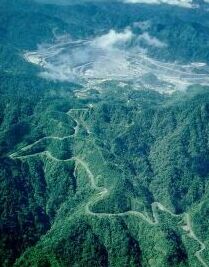 Panguna mine site shrouded in clouds
Another auditor wasn't quite so outspoken to get off the island but did so even more quickly: Frank Joslin was given the monthly "perk" of hand-carrying a batch of punch cards to Bechtel's Melbourne office where he presented himself, never to be seen again thereafter. His neat little trick became known as "doing a Joslin" and was much talked about but never imitated. Some of the new recruits to the audit team were less than delighted with their posting to muddy and rain-soaked Panguna and started counting the days to the end of their twelve-month contract - literally! They ran up an adding-machine strip list from 365 days down to zero and pasted it to the office wall, ticking off one day at a time. Needless to say, not many survived that kind of mental torture. There were some others who never left Aropa airstrip: they had seen the mountain range shrouded in clouds from the aircraft and, refusing to leave the small airline building and spending a fretful night on a hard wooden bench, reboarded the same aircraft for its morning flight back to Port Moresby.
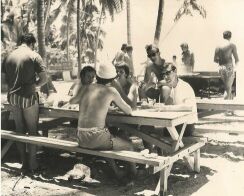 Others took to
the wild camp life with gusto, spending what little time was left after a 10-hour working day, in the "boozer" and even investing in their
own 'fridges outside their dongas. The nights were punctuated by the squeaking of 'fridge door hinges and the squishing sound of rings pulled off beer
cans. A common "status symbol" amongst serious drinkers were door-frame curtains constructed from the hundreds of pull-top rings collected from empty
beer cans. Les Feeney was put in charge of the audit group but more often than not was in charge of the carousing going on in the
"boozer" and endlessly stuffing his pipe but never succeeding in lighting it. He and Peter the "Eskimo", a lumbering polar
bear of a man hailing from Iceland, ran a constant "throat-to-throat" race as to who was the biggest drinker.
"Bulldog", a likeable Pom, tried hard to catch up with them! On one occasion he also tried to learn how to play the
electric organ. He never did but the speakers and amplifier which came with it, were put to good (and all-too-frequent) use when he played his
favourite Neil Diamond record, "Hot August Night." The whole camp rocked when "Bulldog" plugged in that organ! I shall
always associate "Hot August Night" with nights at Camp One!
During my time on the island I became a Justice of the Peace and also obtained my registration as a tax agent (Registration No. TTA322, dated 26th April 1971) and assisted many in the camps with their tax returns. I even made successful representation to the New Zealand Inland Revenue to have the then 18-months "world income rule" set aside for the Kiwis working on Bougainville. Had I not obtained this particular ruling, they would have been liable to pay New Zealand income tax on their Bougainville earnings. I became something of a scribe for many in the camp who wanted to apply for a passport or needed documents authenticated or who - surprisingly - couldn't read or write and asked me to handle their correspondence - including some pretty red-hot love letters!!! I always toned down their replies which must have kept quite a few guys out of troubles!
After Bougainville came stints in the Solomons, back to PNG (setting up the Internal Audit Department for AIR NIUGINI in Port Moresby where I run into Brian Herde again who'd taken a job with Tutt Bryants),
 Rangoon in Burma, Samoa, Malaysia, Indonesia, Iran, PNG once again (setting up the tug-and-barge operations for Ok Tedi; Bechtel was back in town to manage this project and with it came Sid Lhotka with whom I had dinner at the Papuan Hotel in Port Moresby to talk about "old times"), Saudi Arabia (where I met up with Des Hudson again), Greece - but none of those assignments came ever close to the comraderie and esprit de corps of the years on Bougainville!
Over the years I repeatedly ran into "ex-Bougainvilleans" and "ex-Territorians" in Australia and elsewhere. We would swap yarns which always ended in a great deal of nostalgia and a hankering for a way of life that would never come again. Like myself, many had found it difficult to settle back into an "ordinary" life and, like myself, had moved from place to place in an attempt to recapture some of the old life style.


It's probably too much of a stretch to suggest that they waited with the Bougainville Copper Project until the ring-tab beer can had been introduced in 1965, but by the time I had moved into my small construction donga in Camp 6 on beautiful Loloho Beach, the length of stay - not to mention the depth of drinking problem - of a donga inhabitant could be judged by the length of his "door curtain", composed entirely of hundreds of clipped-together beer can ring-tabs.
These "mine-is-longer-than-yours" door curtains were so common that I unfortunately never took a photograph of this "status symbol" in a camp otherwise devoid of any differences, as we all dressed in the same T-shirt and stubbie, all wore the same thongs, all ate in the same mess hall, all crapped and showered in the same ablution block, and drove the same clapped-out and dirt-covered four-wheel-drive company ute.

Is it coincidence that the end of the ring-tab beer can came at about the same time as the end of the Bougainville Copper Project?
Bob Jackson did a tremendous job in joining up a lot of clippings into a "documentary" of his - of our - "Golden Years" on Bougainvile. As he wrote all that many years ago in an email to me:
"Hello Peter
I have looked for years for a web site featuring the "expat workers" view of Bougainville, it was a very pleasant surprise to find yours. I was in Spain at the end of a "too long" holiday, was bored and searching for something familiar, finding it brightened my whole day.
I was a BCL "power house pom" originally hired from Kalgoorlie West Australia (after travelling out overland) . I went there as a single man in 74 to work as an instrument technician in the power house at Loloho, after a couple of years I transferred to Operations as an "assistant unit controller".
I was in Loloho Camp 6 during the first night of the "74 rock festival" and electrified my donga window flyscreen in the hope of "staying alive". We had valiantly emptied our beer fridges to "save the amber fluid". The next night we camped in the power house smoko room after welding up all the doors (but one). We took up guard duty at the front gate armed with 24" stilsons and a length of water pipe, fortunately the riot squad were between us and the rioters so our weapons remained unused.
After a little over three years I left, had a couple of cruises and ended up in Brazil (intending a big S.American trip) but after Bougainville I didn't enjoy it much. I went to UK got married and returned to Bougainville (after a two year absence) to the same job, and living in Arawa Section 6/28. My first child was born in the Arawa hospital in 82 my second child in 85 in Brisbane (after an emergency medivac from Bougainville). I stayed in the power house until Dec 88 ending up as a shift supervisor. I left before the troubles really got started and as such have few bad memories of Bougainville.
Hash house harriers. I first ran with the Loloho Hash House Harriers and on my return joined the Arawa Hash. In the early days Arawa Hash hired a DC3 for a combined run with the Honiara Hash. Later we had 4WD trips to Sohano Island (the old Bougainville District Office) and every one slept in the old District Commissioner's House (or camped on his lawn). I was a shift worker and as such missed many runs but those I did gave me a buzz which kept me going until the next one. The adventure, the running, the beer, it worked for me!
I moved to (and still live) in a house half way between Brisbane and the Gold Coast in a place that I bought on a five day visit from Bougainville. Since leaving Bougainville I've had about thirteen years in local government (working in electrical design).
That's about it (apart from the inevitable divorce and re-marriage) a few years ago.
Keep up the good work with the web site!"
He also put together his own website - click here.