The Die Was Cast - My Journey to New Guinea

News items from Bougainville

The Bougainville Aftermath

For your listening pleasure: TAIM BILONG MASTA

70 years of PIM are now available on the internet - click here

A new online library servicing the Pacific: digitalpasifik.org

RETURN TO TOP OF BLOG

If something on this blog doesn't work, please contact the janitor
Alternatively, contact the Helpdesk

8 September 2019

From the late Brian Darcey's blog: Farewell to New Guinea


The day started normally enough on Bougainville Island. Our office in Toniva, a suburb of the small coastal town of Kieta, opened for business at the usual time and I sat down at my desk after checking the telex (remember telex?) for overnight messages.

A call from our Papuan store manager from the main cargo wharf was the start of what turned out to be the beginning of the end for B F Darcey & Company, and the signal for our exodus from New Guinea.

"Customs say we can't ship that two tons of trocas for Japan."

"Why not? The export entries are in."

"Something about no more shell exports by non-nationals."

I drove to the wharf and found our shipment of bagged trocas shell resting on pallets with a small crowd of locals gathered around it. Manager Jim was glowering at two unsmiling customs officials, one of whom had a proprietorial foot placed firmly on the nearest bag of trocas.

"The law has changed", I was informed. "Dealing in trocas shell is now only for Papua New Guineans and your business can no longer buy, sell or export it".

A check with Port Moresby confirmed this, and was swiftly followed by an offer from an anonymus caller. "Just heard about your problem. I'm a citizen and I'd be happy to buy the trocas from you." A price of less than half the market value of the shell followed.

Thirty years on, a similar situation would present no problems. In today's New Guinea a discreet bundle of money in a plain envelope would result in removal of whatever the impediment was, but in those early post-Independence times bribery was unheard of.

It was 1978, three years after a reluctant Papua New Guinea had been pitchforked into Independence, ready or not, by the Australian Government, and things were rapidly unravelling.

The more prescient private business owners had already either sold up and moved out of the country or converted their firms to a partnership with one or more of their native staff as majority shareholders. This made the business no longer 'foreign' and it could theoretically continue to trade, unhindered by the increasing number of restrictions on business for those now labelled 'non-nationals'.

Finance for the new part-owners was obtained by way of a government-guaranteed bank loan. The more prudent of the former sole owners lost no time in transferring their money out of the country and usually followed it, leaving the business to be run by what was, more often than not, inexperienced and untrained new management. We had not done this and continued to run our Company as a fully owned family business.

We traded in cocoa, coffee, trocas shell, crocodile skins and other tropical commodities. We owned several commercial buildings at Toniva near the port of Kieta, a fleet of 4-wheel drive vehicles, and a twin-engined aircraft which I flew. We ran a retail store which sold everything from artifacts and carvings to women's clothing and jewellery, and we lived in a house which we had built on the beach at Toniva, a short walk away from the office and stores.

'Head in the sand' accurately describes the mindset of the Darceys and many other expatriates in those post-Independence years. The children, especially our young daughters, in the years immediately before our departure, had been increasingly exposed to aggressive and intimidating behaviour from young males in the streets and elsewhere and they were ready to leave long before their parents.

We were constantly getting unwanted and unpalatable advice to "sell out and get out" from former residents of similar places to Papua New Guinea who had moved there after their lives in Africa and Southeast Asia had been made uncomfortable, unsafe, or both.

We did not listen to them. New Guinea had been home for over 30 years. All four children had been born there, and life was prosperous and enjoyable. Where would we go? Australia was fine for holidays and a good place to send the children for their secondary education, but not a place where we wanted to live.

Those who did move were easy targets for sellers of all kinds of fringe investments in Australia. Macadamia plantations, Ti Tree farms, Avocado orchards and other trendy investment schemes were only some of the means used to separate returning New Guinea residents from their money.

We stayed on, coping with an every increasing level of interference from the new Papua New Guinea Government, and a studied refusal to continue anything other than a benevolent 'hands off' by the Australian Government while it continued to send millions of Australian Dollars in untied annual grants to its former Trust Territory.

Life started to unravel very quickly. We finally realised that it really was time to go: that the New Guinea we had known and called home for over 25 years was fast vanishing, and we were no longer welcome.

Panguna, now one of the biggest open-cut mines in the world, was facing rapidly developing opposition from disgruntled Bougainville villagers, overwhelmed by the transformation of their island into an industrial maelstrom of men and machinery; something they had not asked for and did not understand.

Plantations, which continued to produce the copra and cocoa on which the new nation relied on to supplement Australian aid dollars were finding the cheap, reliable labour on which these enterprises depended harder to obtain: workers had become less and less amenable to the ordered monotony of plantation life which required the labourer to rise before dawn six days out of seven for two years before returning to the indolent stop-start pattern of village life.

The police force lost almost all its experienced expatriate officers. The force now followed the same pattern as other government departments, rapidly promoting junior officers to senior positions far above their level of experience or competency. For the first time, bribery and corruption started to infiltrate commercial life. It has now become the norm, and very little can be accomplished without it in today's PNG.

By the time the reality of all this had sunk in, the possibility of finding a shadow local partner had come and gone. Banks and other lenders were now very reluctant to finance such arrangements, and the only thing left to do was to sell our physical assets, houses, buildings and vehicles etc.

This was still possible, but it was a buyer's market and values were less than a third of what could have been obtained a few short years previously. The commercial buildings were bought by Hagermeyer, a Dutch trading firm far more experienced in dealing with new Third World governments than I was. Our house went to an Australian bank whose manager lost no time in moving into a far more comfortable home than that formerly provided by his employers. The fleet of vehicles was bought by a local dealer with the exception of my Volvo which was shipped to Australia together with furniture and personal effects including an extensive library of New Guinea and Solomon Islands books and papers. Our leased bulk store was returned to its owners and our aircraft was loaded for a last flight from Kieta to Cairns in North Queensland.

Divested of all its assets, our now unsaleable business was placed in voluntary liquidation and life in New Guinea ended in a mixture of sadness to be leaving and relief at escaping the increasingly hostile and insecure atmosphere which now prevailed.

Was it all worth it? Yes, it was. We should have faced reality and got away sooner, but for all but the last few years, New Guinea gave us a safe, satisfying and adventurous lifestyle with an income far greater than we would probably have achieved in Australia. We had more than enough money to start again in Australia, which begged the question, "What now?"

The above was copied from the archived copy of Brian Darcey's website www.darceyco.com. Brian will always owe us his answer to the self-posed question "what now?" as, sadly, he passed away on 14 May 2018 in Cairns. I briefly visited and stayed with him on his yacht TEKANI II a few years earlier - see here and here -, and I am sure he would have liked me to preserve his writings. He is also the author of "Bougainville Blue" - see here.


6 September 2019

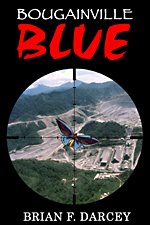
Bougainville Blue


In the early 2000s, Brian Darcey wrote a book, "Bougainville Blue", which is about Bougainville and named after its spectacularly beautiful butterfly but also about a ‘blue’ which is Australian slang for a fight. It’s about the beauty of Bougainville and its flora and fauna. And it's about the destruction of Bougainville.

Brian and his family lived in Papua New Guinea for twenty-five years, from 1955 to 1980. He was the original Rabaul agent for CRA Exploration when he operated B.F.DARCEY & COMPANY PTY LTD at Rabaul until 1965, then at Toniva on Bougainville Island. They were cocoa and trochus shell exporters, but also had a store at Toniva selling artifacts, jewellery, clothing etc.

"Bougainville Blue" is a work of fiction but it also tells the reader about the Panguna Mine which was closed by a ragtag militia bent on reclaiming their land. Brian saw the Bougainville Revolutionary Army come into being. He observed the rise and fall of Australian rule in Bougainville. He watched the ‘blue’ take place. Listen to an interview Brian gave in 2008: click here or here.

"Bougainville Blue" is still available by mail order from Diane Andrews, email dianepithie@gmail.com, for $28, including postage.


5 September 2019

The Highlands Trilogy


Read more here


For anyone interested in the early days of European exploration of New Guinea, this three-in-one documentary series filmed over a ten-year period - "First Contact" (1983), followed by Joe Leahy’s "Neighbours" (1989) and "Black Harvest" (1992), - offers footage of exceptional quality considering that it is twenty to thirty years old.

Youtube has some short clips:


First Contact


Black Harvest


First Contact - The Day the Plane Came


PNG Highlands Trilogy from Music Films Distribution on Vimeo.


Occasionally, the full set of DVDs is on sale at ebay at around a hundred dollars, not an unreasonable price considering its rarity.

The DVDs as well as the book are also available direct from the producers - click here.


BAMAHUTA - Leaving Papua

People who lived and worked in Papua New Guinea prior to 1975 when independence was prematurely thrust on an ill-prepared and largely unwilling population by the Australian Government, are becoming thin on the ground as the years roll on.

Most former colonies including PNG have coped with their new status with varying degrees of success, and a recently republished book by former 'kiap' Philip Fitzpatrick would be a welcome addition to any collector of stories written by the men who brought youth, stamina and dedication to the task of preparing a stone age country for political independence .

Rescued from its out-of-print oblivion by niche publisher Diane Andrews of Cairns, "Bamahuta - Leaving Papua" reeks of authenticity and personal acquaintance with the people of Papua New Guinea by a writer who lived and worked with them as a kiap in the final years of Australia's occupation of Papua from 1967 to 1973, two years before independence.

Like others who returned to PNG after 1975, Philip returned from time to time after the departure of the Australian administration, and was appalled and saddened by the shambolic and lawless depths to which the country he knew and loved had descended. The opening chapter of the book has a vivid account of an armed payroll hijack at a remote airstrip which Fitzpatrick survived after his driver was shot and badly injured. It makes gripping reading.

There is much humour and wry comment by this percipient and acute observer of mankind, both black and white, some of it racier and more personal than in books written by former kiaps like Ivan Champion, Jack Hides and J K McCarthy, but it deserves a place alongside these in the Papua New Guinea section on your bookshelf.

The once out-of-print book is now available from its new publisher by email at dianepithie@gmail.com


1 September 2019

PNG Geography 101


 :

... and while we're on Youtube, here are some more:


30 August 2019

Fond memories still endure

Over the picturesque, green jagged terrain of Bougainville’s Crown Prince Range, the Panguna mine has sat idle for more than 30 years.

It is a mine with a chequered and somewhat haunting past due to its association with some of the island’s darkest days. Tracing its history takes us back to 1966 when intrepid geologists confirmed the existence of vast copper and gold ore deposits in the Panguna valley. By 1972 the mine was in full operation under Bougainville Copper Limited (BCL), a subsidiary of mining giant Rio Tinto, formerly CRA.

On the 15th May 1989, production came to a halt as a result of militant activity which escalated into a civil war. Land rights and the distribution of Panguna mining profits were among some of the issues central to the hostilities.

In the 17 years prior to 1989, the mine produced concentrate containing 3 million tonnes of copper from one of the largest concentrations of copper phosphate anywhere in the world. In addition, Panguna also yielded 306 tonnes of gold and 784 tonnes of silver. The mine had a production value of 5.2 billion Kina and accounted for 44 per cent of PNG’s exports during its period of operation.

Around 1.2 billion Kina was contributed in taxes, duties, dividends and other payments to the PNG government, the former North Solomons Provincial Government and Panguna landowners which represented about 62 per cent of the net cash generated by the project.

During the mine’s life, Bougainville Copper also trained some 12,000 employees, including around 1,000 full trade apprentices and some 400 who completed tertiary studies. This upskilling enhanced the capacity of the national workforce and benefited other areas of the economy after Panguna’s closure. The practices put in place by Bougainville Copper continue to positively impact the global mining industry to this day.

To read the full article, click here


19 August 2019

Taim Bilong Masta

This book is freely accessible from the ANU Open Research Library - click here


Long after I had left New Guinea and on one of my frequent business trips from Saudi Arabia back to Australia, I was killing a bit of time in the ABC Shop in Adelaide's Rundle Mall when I found a set of twenty-four audio cassettes labelled "TAIM BILONG MASTA - Australia's Involvement with Papua New Guinea".

Of course, I bought them right away and for years I listened to them over and over again as, in the absence of any proper television or radio reception in the world's biggest sandbox, they had become my daily nightcap to drown out the howling desert winds.

I believe the creator of those tapes, ABC presenter Tim Bowden, is still around but not so those twenty-four precious cassettes which over the years, just like myself, had become warped and worn. In later years, I did buy the book by the same name but there's nothing quite like listening to those old familiar voices and I had been searching high and low for those recordings but without success - until now!

A kindly soul, Kieran Nelson, who grew up in New Guinea, worked for the Papua New Guinea Banking Corporation (PNGBC) and now lives in Brisbane, undertook the enormous labour of love of putting all twenty-four cassettes onto youtube for our continued listening pleasure:


mp3 files:

Episode 1 Never a Colony

Episode 2 The Good Time Before

Episode 3 God's Shadow on Earth

Episode 4 The Loneliness and the Glory

Episode 5 On Patrol

Episode 6 Sailo

Episode 7 The Boat Came Every Six Weeks

Episode 8 Masta Me Like Work

Episode 9 The Violent Land

Episode 10 Moneymakers and Misfits

Episode 11 Wife and Missus

Episode 12 Growing Up

Episode 13 Into The Highlands

Episode 14 The Promised Land

Episode 15 First Contact

Episode 16 Gold

Episode 17 The Good News

Episode 18 The Mission Rush

Episode 19 You Had To Be Firm

Episode 20 Across the Barriers

Episode 21 Courts and Calaboose

Episode 22 War

Episode 23 A Reason For Being There

Episode 24 Going Finish


P.S. ... and while I have your attention, I might as well give the 1950s feature film "Walk into Paradise" a much-deserved plug:


If the trailer whetted your appetite, then click here and lash out on this cinematic treat. At only $15 it's the best souvenir you're ever going to get from New Guinea.

Meanwhile, watch the full-length movie here, before it disappears again.


14 August 2019

Island in Transition

To stay alive, this blog is undergoing a slow transformation from being a voice for those who built the mighty Bougainville Copper Project in the early 70s to a general collection of 'New Guineana'. Why? Well, many of those who worked on the project are already dead or - if past performances are anything to go by - in the process of drinking themselves to death. Some others who could still write can't because they never learned how - and you better believe it because as a tax agent in Camp 6 and later in Camp 1 I also became something of a scribe for those who wanted to communicate with their wives and sweethearts but couldn't. They came to me to read out their letters to them or to pen their replies - and I believe I kept many out of mischief by toning down their replies by several degrees! Anyway, here we go with another piece of 'New Guineana':

Click on image to enlarge


6 August 2019

In A Savage Land


A rare movie. Enjoy!


4 August 2019

Tok Pisin